



Accessing the Knowledge Center effectively requires a simple, one-time registration.
Search Results (130)

Impact of Different Hybrid-Electric Architectures on CO2 and NOX Emissions of a Diesel-Powered LCV: a Simulation Study
According to EU legislation, CO2 emissions from Light Commercial Vehicles (LCVs) must decrease by 15% in 5 years and by 31% in 10 years from now. This, combined with the proliferation of Low Emission Zones (LEZ) in urban areas, is driving the automotive industry towards an ever-increasing electrification of LCV powertrains. In this work, simulation is employed to assess the impact of three different hybrid electric architectures on CO2 and NOX emissions, on a Diesel-powered LCV. As a first step, a model representing a conventional N1 segment vehicle endowed with a 2.0Lt turbocharged Diesel engine, was built in GT-SUITE. Then, three alternative variants of the original model were prepared: a 48V P0 Mild-Hybrid Electric Vehicle (MHEV), a 48V P2 MHEV and a 400V P2 Plug-in Electric Hybrid Vehicle (PHEV).

Investigation of the Relative Performance of Vaned and Vaneless Mixed Flow Turbines for Medium and Heavy-Duty Diesel Engine Applications With Pulse Exhaust Systems
This paper details results of a numerical and experimental investigation into the relative performance of vaned and vaneless mixed flow turbines for application to medium and heavy-duty diesel engines utilizing pulse exhaust systems. Previous investigations into the impact of nozzle vanes on turbine performance considered only open turbine housings, whereas a majority of medium and heavy-duty diesel engine applications are six-cylinder engines using pulse exhaust systems with divided turbines.
The two turbine stages for this investigation were carefully designed to meet the constraints of engines with pulse exhaust systems and to control confounding factors that would undermine the vaned vs vaneless performance comparison. Detailed CFD analysis and turbine dynamometer test results confirm a significant efficiency advantage for the vaned turbine stage under both full and partial admission conditions.
A New Generation Lean Gasoline Engine for Premium Vehicle CO2 Reduction
In an era of rapidly increasing vehicle electrification, the gasoline engine remains a vital part of the passenger car powertrain portfolio. Lean-burn combustion is a formidable means for reducing the CO2 emissions of gasoline engines but demands the use of sophisticated emissions control.
SWUMBLE 3-Cylinder High Efficiency Gasoline Engine for Future Electrified Powertrains
Stringent worldwide CO2 targets are leading the automotive industry towards carbon neutrality. Although the deployment of electric vehicles is part of the solution, a large part of the manufactured vehicles in 2030 will feature advanced hybrid architectures and will continue to be equipped with internal combustion engines. In this context, improvements in engine efficiency are still very important to reduce the CO2 emission of the vehicle. In parallel, it has become mandatory to reduce pollutant emissions in all driving situations to make the use of combustion engines acceptable in as many areas as possible.
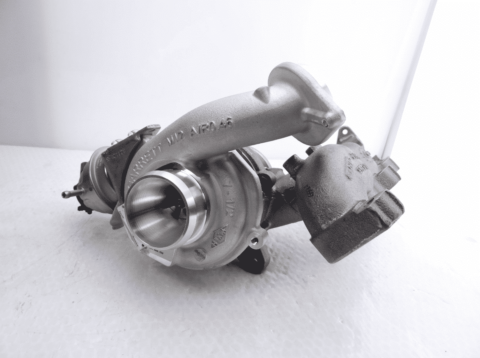
Technical Bulletin: VW 2.0 L – 836026-5005S Turbocharger Replacement
This Technical Bulletin covers the turbocharger replacement for Garrett part number 836026-5005S for VW 2.0 L. Learn more about turbochargers.
The smallest CV VNT (TM) developed for Euro VI+ & Japan PPNLT light duty commercial applications with extreme braking
Challenging emissions and fuel consumption legislations across the globe drive continuous evolution of VNTTM turbocharger technologies. In the light duty (100 kW – 140 kW engines) commercial vehicles segment, this challenge is further complicated by high cost-sensitivity and unique packaging constraints. Moreover, due to engine down-sizing, light duty commercial vehicle powertrains need to expand their range to cover a portion of medium duty vehicle applications as well.
SC-VNT™ a route toward high efficiency for Gasoline Engines
CO2 targets and anticipation of Eu7 Legislation is accelerating the widespread adoption of VNT turbochargers for Gasoline engines. VW set the industry best BSFC of 222 g/kWh when it released its 1,5L EA211 Miller engine with a Garrett GT12V in the Vienna Motor Symposium in 2017 [1,2]. Since this time engine ratings and VNT product ranges have been expanded and it is now expected that we will see new releases from several OEMs in multiple applications from 2020 onwards.
Electric Turbo, a Technology for Stoichiometric Combustion and Increased Efficiency
The next Euro 7 Emission Regulation will probably require gasoline engines to have full λ=1 combustion operation, in order to limit production of pollutants deriving from rich combustion. Since such operation will significantly limit engine output, few technologies as water injection, cooled exhaust EGR, variable compression ratio, integrated cooled exhaust manifold, Miller cycle with Variable Turbine Geometry and, more recently, electric turbocharger have gained visibility for the purpose of maintaining power density and displacement.
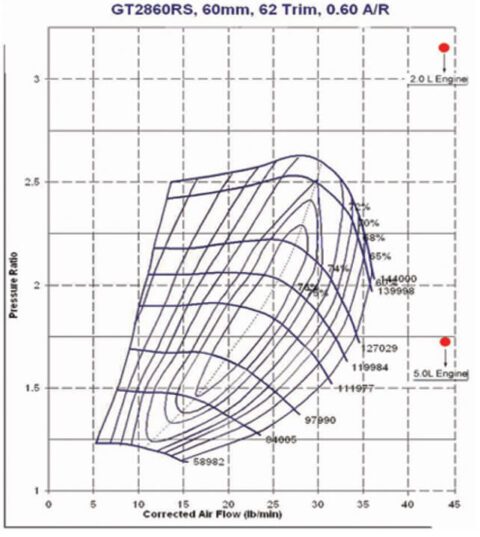
How a Turbo Works – Turbo Compressor Map – Expert Knowledge
This article will describe parts of the compressor map, how to estimate pressure ratio and mass flow rate for your engine, and how to plot the points on the maps to help choose the right turbocharger.
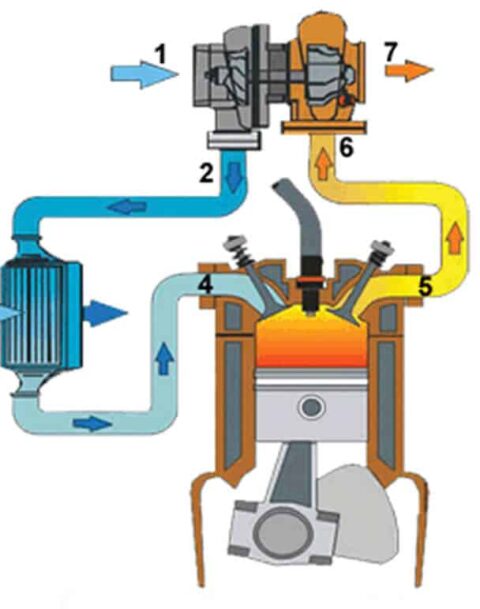
How a Turbocharger Works – Turbo Basic Knowledge Guide
Get to grips with the Garrett turbo basics covering blow-off valves, wastegates, oil and water plumbing, and journal bearings vs. ball bearings.
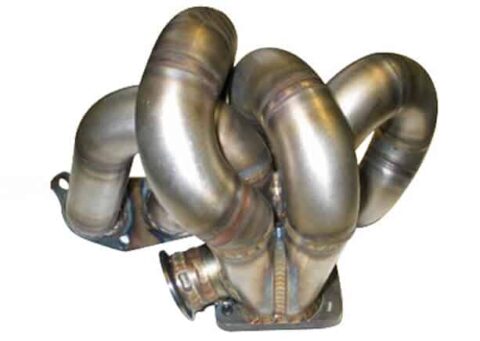
How a Turbo Works – Turbo Advanced Knowledge
Step up a level and explore wheel trim, turbine housing A/R and housing sizing, log-style vs. equal length manifolds, compression ratio with boost, and air/fuel ratio tuning: rich vs lean.