



GXR47-80 Dyno Results: 1512 RWHP on a 3.0L 2JZ
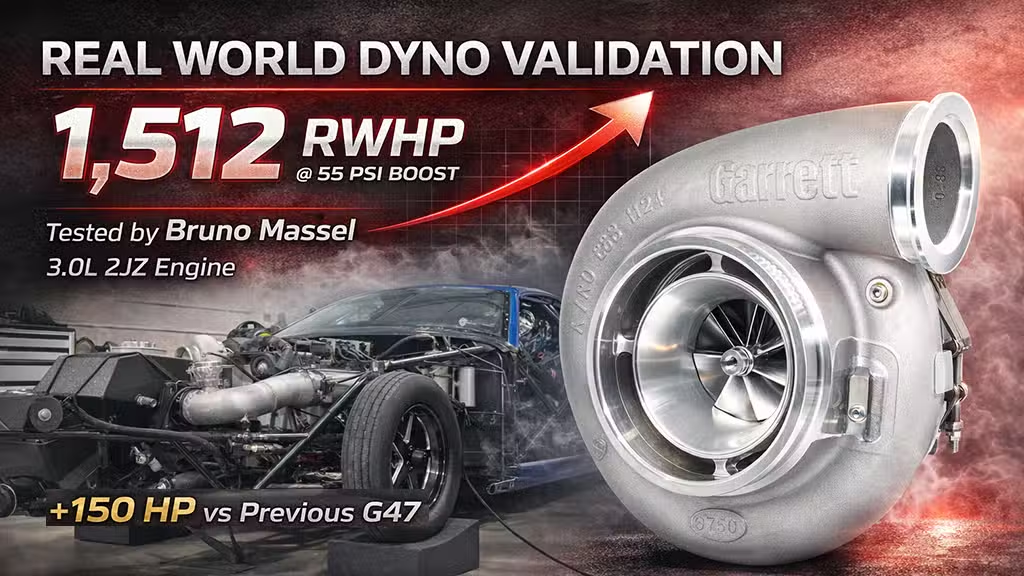
Real-world dyno validation of the Garrett G-XRace GXR47-80 turbocharger tested by Bruno Massel on a 3.0L 2JZ engine producing 1,512 rear wheel horsepower at 55 PSI boost
Real World Validation of the GXR47 Platform
Independent dyno testing of the Garrett GXR47 platform, conducted by Bruno Massel using a GXR47-80 configuration, demonstrates the airflow and performance capability of the GXR47 turbo architecture. Tested on a proven championship-winning platform, the GXR47 represents a measurable step forward in turbocharger performance under real racing conditions.
The Car Behind the Data
This testing was performed on a 2010 Chevy Cobalt Pro Stock chassis built to meet NHRA specifications and competing in NHRA Comp Eliminator. Originally developed as a Pro Stock car, the program evolved by pushing beyond traditional combinations. The team first ran a turbocharged Chevy Ecotec engine before transitioning to a turbocharged 2JZ platform, a move that resulted in two additional NHRA World Championships in 2021 and 2023. Today, the car is powered by a 3.0L 2JZ and utilizes Garrett turbochargers and intercooling, paired with a Bruno drive and 5-speed Lenco transmission. This is not a theoretical setup. It is a proven race car that has delivered results at the highest level of competition.
Why Garrett
According to Bruno Massel Racing, turbocharger selection is driven heavily by class rules and real-world performance requirements. Spool time is critical, especially in a category where nitrous assistance is not allowed. The ability to generate boost quickly and efficiently directly impacts performance on track. In their words, Garrett turbochargers spool faster than anything they have tested and are capable of producing more boost with less backpressure. That combination delivers both performance and confidence when pushing the limits of the car.
Dyno Performance Results
During testing, the GXR47-80 produced: 1,512 rear wheel horsepower at 55 psi of boost. This was achieved with approximately 10 percent converter slip, indicating the system was not fully coupled during the pull. According to Bruno, the GXR47 delivered approximately 150 more rear wheel horsepower than the previous G47 combination, with additional power still available. Testing was stopped early due to an injector failure, but the data clearly showed a meaningful performance gain.
Performance Improvement Over G47
According to Bruno Massel, the GXR47 delivered approximately 150 more rear wheel horsepower than the previous G47 combination, with additional power still available. Testing was stopped early due to an injector failure, but the data clearly showed a measurable increase in performance. The previous G47 combination produced 49 psi of boost at the track. The GXR47 achieved 55 psi on the dyno with additional boost still available. On this setup, each additional pound of boost corresponds to roughly 25 horsepower.
Backpressure to Boost Ratio
54 psi backpressure to 55 psi boost. This near one to one relationship highlights strong turbine efficiency under load.
Built for Restricted Racing Classes
Class rules limited the mechanical setup, placing greater emphasis on turbocharger efficiency, spool, and usable power without relying on nitrous or extreme boost levels. G-XRace is designed for class-specific drag racing where restrictions are placed on the compressor inducer and exducer. Garrett has engineered and manufactured turbochargers in this product line to maximize horsepower for these rule sets. G-XRace turbochargers feature a split blade design that maximizes pressure ratio and flow capability which is where drag racing engines need boost pressure and flow to support their horsepower targets to stay competitive.
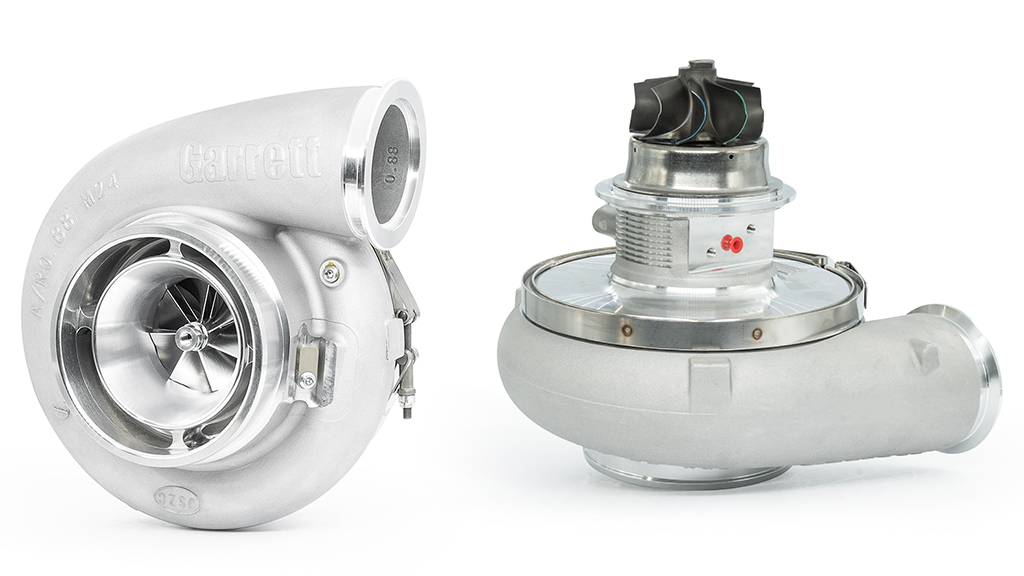
Garrett G-XRace GXR47 turbocharger engineered for high horsepower drag racing applications
Track Performance and Proven Results
Before transitioning to the GXR platform, the car had already demonstrated elite performance, running as quick as 6.49 seconds at 209 mph in the quarter mile.
Following Garrett turbocharger development and continued optimization, performance improved to 6.35 seconds at 213 mph, reinforcing gains in both power and efficiency.
The team has achieved:
- 4 NHRA World Championships
- 6 divisional championships
- The only turbocharged car to win in this category in over 40 years
This level of success validates not just the turbocharger, but the entire system working together under competitive pressure.
Key Takeaways
- Increased airflow capability compared to the previous generation
- Improved turbine efficiency under high load
- Faster spool in restricted racing environments
- Stronger top-end power and overall pull
- Increased driver confidence when pushing the car
Conclusion
The GXR47 turbo platform represents a significant advancement in airflow, efficiency, and power capability for competitive drag racing. This is not theoretical performance. It is validated on a championship-winning car, under real racing constraints, by a team that expects results. There is more performance left in the combination. The data already proves that.
Looking Ahead. The team is transitioning from twin G35-900 turbochargers to a single GXR47 configuration for the 2026 season. With the season beginning in May, expectations are clear. The goal is not incremental improvement. It is to exceed previous performance benchmarks and continue winning at the highest level.
Disclaimer
Testing results shown were achieved using the Garrett GXR47-80 configuration. Performance of other GXR47 variants, including the GXR47-76, GXR47-88 will vary depending on compressor selection, engine combination, calibration strategy, fuel, and vehicle setup.
Find a Distributor
Connect with an authorized Garrett distributor for pricing and availability.